
Beyond the First Impression: How to Evaluate a Fragrance Essence Like a Professional

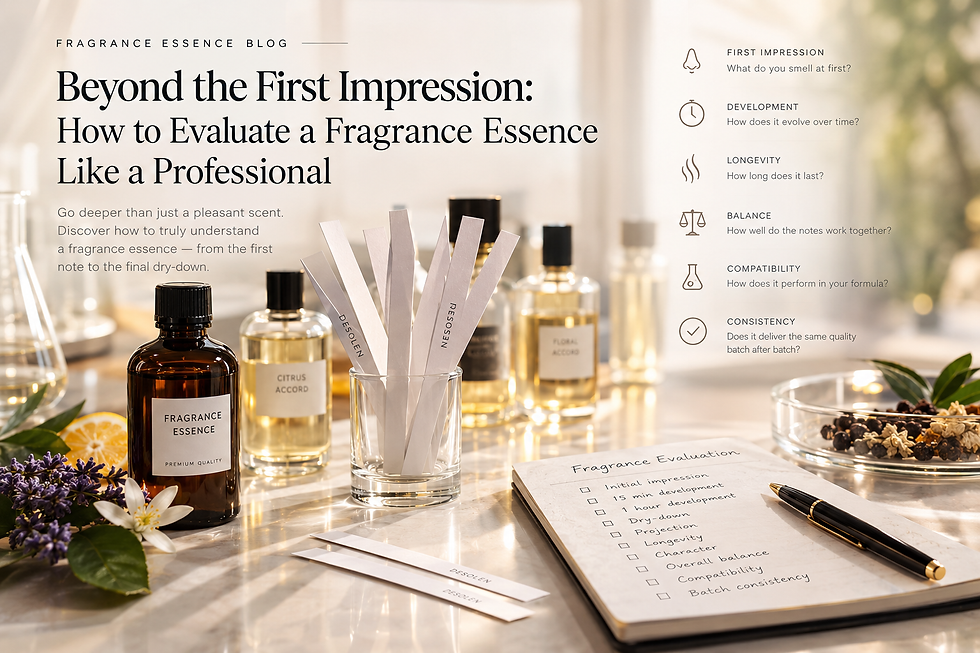
Choosing a fragrance essence often begins with a simple question:
“Do I like the way it smells?”
But when fragrance becomes more than a personal preference—when it is used to create perfumes, cosmetics, home fragrances, detergents, or other scented products—the evaluation process becomes much more detailed.
A beautiful first impression is important, but it is only the beginning.
A professional fragrance evaluation looks at how the scent develops, how consistent it remains, how it interacts with the final product, and whether it delivers the desired olfactory experience from the first application to the final dry-down.
So, how can you evaluate a fragrance essence beyond simply smelling it?
1. Start With the First Impression—but Don't Stop There
The opening of a fragrance is often what attracts us first.
Fresh citrus, fruity notes, aromatic ingredients, spices, or sparkling accords can create an immediate impact. This first impression is important because it determines how a fragrance initially communicates with the user.
However, some fragrances are designed to make a dramatic opening, while others are intentionally softer and more gradual.
A strong opening does not automatically mean a better fragrance.
When evaluating an essence, ask yourself:
Is the opening pleasant?
Does it feel balanced?
Are individual notes competing with each other?
Does the fragrance feel natural and coherent?
Does the character remain recognizable after the first few minutes?
The first few seconds tell you about the introduction of a fragrance.
They do not tell you the whole story.
2. Follow the Fragrance Through Its Entire Development
A professional evaluation should never be based on a single moment.
Try evaluating the fragrance at several different stages:
Immediately after applicationWhat is the first impression?
After 15–30 minutesWhich notes are becoming more prominent?
After 1–2 hoursHas the character changed significantly?
After several hoursWhat remains on the skin or test strip?
This process can reveal something that is impossible to notice during a quick smell test.
A fragrance may begin with bright citrus and gradually develop into a woody, musky, amber, floral, or sweet character.
That transformation is not a weakness.
It is often one of the most interesting aspects of fragrance design.
3. Learn to Separate "Strong" From "Long-Lasting"
One of the most common misconceptions in fragrance is that a strong scent must also be long-lasting.
These are two different characteristics.
A fragrance can have an extremely powerful opening but become faint relatively quickly.
Another fragrance may open more softly but remain noticeable for many hours.
This is why fragrance performance should be evaluated through at least two separate questions:
How noticeable is it?
and
How long does it remain noticeable?
Projection, diffusion, intensity, and longevity are related, but they are not identical.
Understanding this difference is particularly important when selecting fragrance essences for commercial formulations.
How to Evaluate a Fragrance Essence Like a Professional
4. Evaluate the Balance, Not Just Individual Notes
A fragrance may contain beautiful ingredients and still feel unbalanced.
Imagine a composition containing citrus, flowers, woods, vanilla, musk, and spices.
Each individual element may smell attractive on its own.
But the final fragrance depends on how these materials interact.
A good fragrance composition creates a relationship between its different parts.
One note should not necessarily dominate everything else.
Instead, the composition should create a recognizable overall identity.
This is why professional fragrance evaluation focuses on the composition as a whole, rather than simply asking which individual note smells the best.
5. Test the Essence in the Application It Was Designed For
An important point is often overlooked:
An essence does not exist in isolation.
The same fragrance composition may behave differently depending on where it is used.
A fragrance intended for:
Fine fragrance
Body care
Soap
Shampoo
Detergent
Fabric softener
Air freshener
Reed diffuser
Candle
Other scented products
may require different performance characteristics.
For example, an essence that smells excellent on a fragrance blotter may behave differently after being incorporated into a finished product.
The base, solvent, concentration, pH, temperature, and other ingredients can influence the final result.
Therefore, if you are selecting an essence for production, testing it only on a blotter is not enough.
6. Don't Judge an Essence Before Testing Its Compatibility
One of the most important steps for manufacturers is compatibility testing.
An essence can smell excellent by itself but behave differently once it is added to a formulation.
Possible changes may include:
Cloudiness
Color changes
Separation
Reduced fragrance impact
Changes in diffusion
Unexpected interactions with the base
Changes during storage
This is why a professional evaluation should include a small laboratory or production sample whenever possible.
A simple sample test can reveal problems long before they become expensive production problems.
7. Consistency Matters as Much as the Scent
Imagine receiving an essence today and creating a successful product with it.
Then, a few months later, you order the same fragrance and notice that the character has changed.
For a manufacturer, this can be a serious issue.
Customers expect a product to smell the same from one batch to another.
This makes batch consistency an important part of fragrance quality.
When selecting an essence supplier, it can therefore be useful to consider more than the fragrance itself.
Look at:
Batch consistency
Product documentation
Stability
Technical support
Application suitability
Packaging
Storage recommendations
Supplier reliability
A beautiful fragrance is valuable.
A beautiful fragrance that can be reproduced consistently is even more valuable for production.
8. Ask What You Actually Want the Fragrance to Achieve
Before choosing an essence, define the objective.
Do you want:
Immediate impact?
Choose a composition with a noticeable and attractive opening.
A soft and elegant character?
Look for balance and smooth development.
Long-lasting presence?
Evaluate the dry-down and substantivity rather than judging only the opening.
A fresh and clean impression?
Explore citrus, aromatic, green, aquatic, and clean accords.
A warm and luxurious atmosphere?
Consider amber, woods, vanilla, musk, resinous, and spicy compositions.
The right essence depends not only on what smells good, but also on what the fragrance needs to accomplish.
9. Build a Fragrance Evaluation Routine
If you regularly work with fragrance essences, creating a simple evaluation system can make comparisons much easier.
For every sample, record:
Fragrance name:Application:Initial impression:15-minute development:1-hour development:Dry-down:Projection:Longevity:Character:Overall balance:Compatibility with base:
You can even create your own fragrance library and compare new samples against previously tested compositions.
Over time, this becomes extremely useful.
Instead of relying entirely on memory, you build a structured understanding of the fragrance materials you work with.
10. The Best Essence Is the One That Fits the Formula
There is no universally perfect fragrance essence.
An essence that works beautifully in one application may not be the right choice for another.
The real question is not:
“Is this a good fragrance essence?”
A better question is:
“Is this the right fragrance essence for this formulation, product, and customer?”
That change in perspective can completely transform the way fragrance is selected.
A professional fragrance decision considers the entire journey—from the first impression to the final dry-down, from the fragrance concentrate to the finished product, and from the laboratory sample to the customer's experience.
From Smelling to Understanding
Fragrance is both an art and a technical discipline.
Your personal preference will always matter, but understanding how an essence behaves gives you another level of control.
The next time you evaluate a fragrance essence, don't simply ask:
“Do I like it?”
Ask:
How does it develop?How does it perform?How does it interact with the formulation?Is it consistent?Does it create the experience I want?
Once you start asking these questions, you stop simply smelling fragrances.
You start understanding them.
And that is where fragrance selection becomes much more than choosing a pleasant scent.
Comments